Consulting Areas
Annual Cathodic Protection Surveys
We typically respond within one business day.
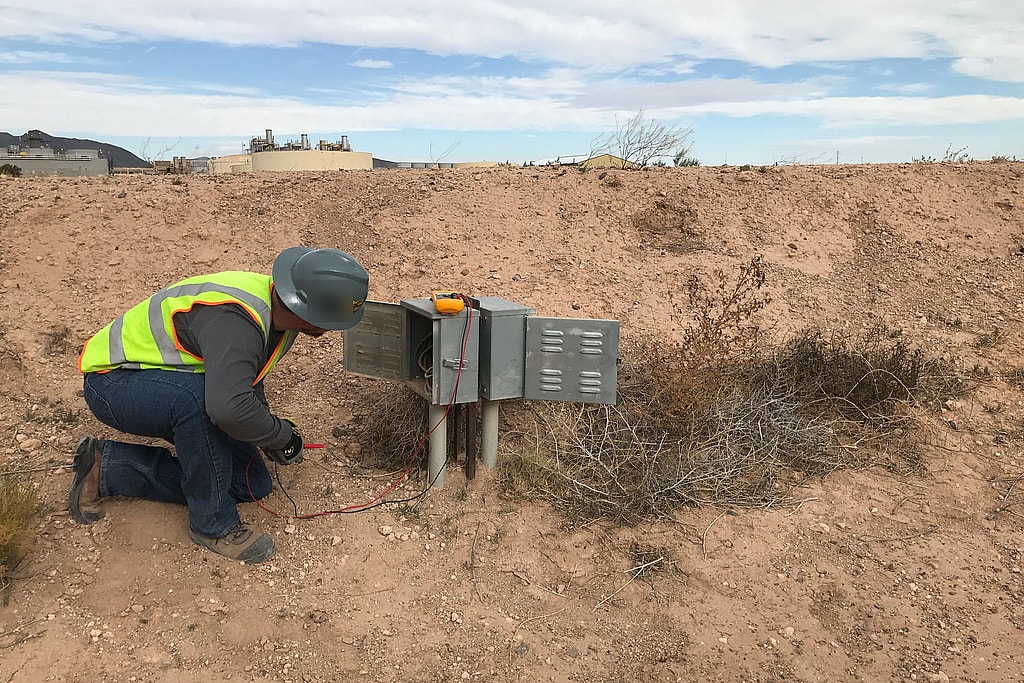
What an annual cathodic protection survey covers
An annual cathodic protection survey is the yearly check that a CP system is still protecting the steel it was built to protect. On a regulated pipeline it is a federal requirement: under 49 CFR 192.465 for gas and 49 CFR 195.573 for hazardous liquids, every cathodically protected line has to be tested at least once each calendar year, with no more than 15 months between tests. The same program also has to cover the rectifier and bond checks that come due during the year and the periodic re-evaluation of any unprotected pipe.
Dreiym Engineering runs these surveys, and the work that follows them, for pipeline operators, plants, water systems and tank owners from our offices in Coldspring, Texas and Westcliffe, Colorado. This page describes the service: what we test, how a survey runs and what you receive. For a plain-language walk through the rules themselves, see our article Annual Cathodic Protection Survey: What 49 CFR 192.465 Requires.
Which checks are required, and how often
The federal calendar for regulated pipelines, and the separate rule for underground storage tanks, look like this:
| Requirement | Minimum frequency | Rule |
|---|---|---|
| Pipe-to-soil tests on protected pipelines | Once each calendar year, intervals not exceeding 15 months | 49 CFR 192.465(a), 195.573(a) |
| Gas: separately protected short sections (100 feet or less) and service lines, where annual tests are impractical | At least 10 percent each year, a different 10 percent each year, so the whole system is tested every 10 years | 49 CFR 192.465(a) |
| Rectifiers and other impressed current sources | Six times each calendar year, intervals not exceeding 2 1/2 months | 49 CFR 192.465(b), 195.573(c) |
| Gas: physical inspection of remotely monitored rectifiers | Once each calendar year, intervals not exceeding 15 months | 49 CFR 192.465(b)(2) |
| Reverse current switches, diodes and interference bonds whose failure would jeopardize protection | Six times each calendar year, intervals not exceeding 2 1/2 months | 49 CFR 192.465(c), 195.573(c) |
| Other interference bonds | Once each calendar year, intervals not exceeding 15 months | 49 CFR 192.465(c), 195.573(c) |
| Re-evaluation of unprotected pipe | At least every 3 years, intervals not exceeding 39 months | 49 CFR 192.465(e), 195.573(b) |
| Underground storage tanks with cathodic protection | Within 6 months of installation, then at least every 3 years; impressed current systems also inspected every 60 days | 40 CFR 280.31 |
Records matter as much as readings. Under 49 CFR 192.491 and 195.589, test and survey records have to be kept for at least 5 years, and the annual survey and unprotected pipe records for as long as the pipeline stays in service. Hazardous liquid operators also have to inspect the cathodic protection on the bottoms of aboveground breakout tanks under API® RP 651 (49 CFR 195.573(d)). Intrastate pipelines in Texas answer to the Railroad Commission of Texas. Plant piping, water lines and tanks that fall outside these rules can follow the same yearly calendar, and a survey every year is the simplest way to catch a failing system before the steel does.
How we run an annual survey
- Records and calendar review. We start from last year’s report, the test station list and maps, rectifier settings and the list of bonds, diodes and switches. The survey date is set so the 15 month limit is never crossed, and the rectifier rounds are scheduled inside their 2 1/2 month window.
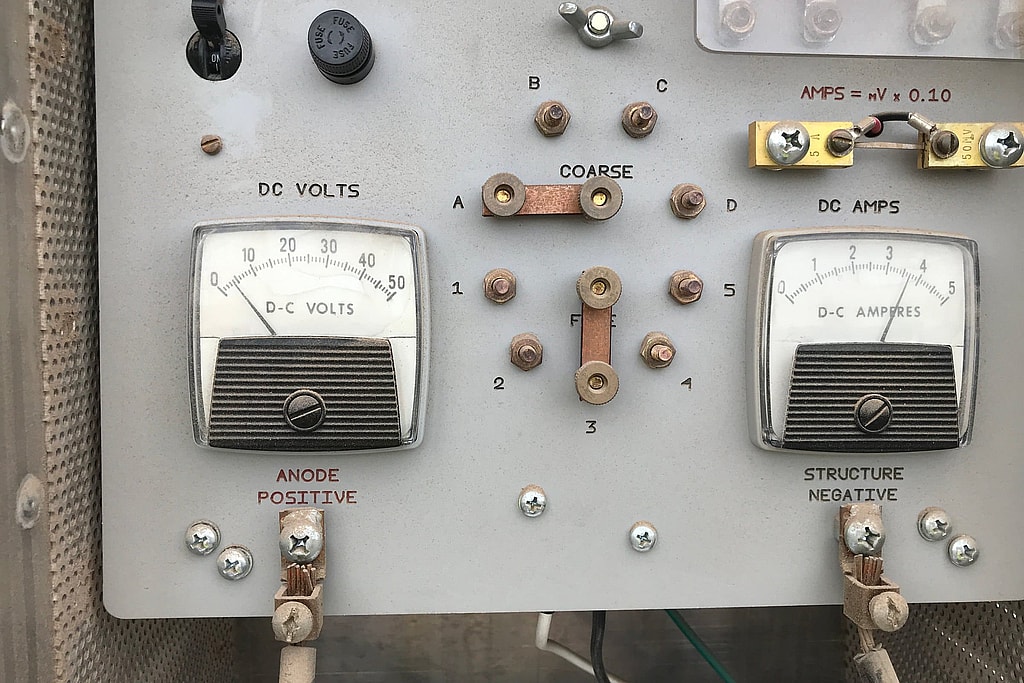
- Rectifier inspection. Output voltage and current, tap settings and condition are recorded, and where the junction box has shunts, the current from each anode. Comparing these with earlier years shows a groundbed that is drying out or an anode that has quit.
- Current interruption. GPS-synchronized interrupters are installed on every rectifier that influences the section, cycling on a short repeating schedule such as 4 seconds on and 1 second off, so the instant-off potential can be read.
- Test station readings. On and instant-off structure-to-soil potentials are taken at each test station, riser and valve setting, against the criteria the operator has adopted: appendix D of Part 192 for gas, or the NACE SP0169 criteria that 49 CFR 195.571 points to for liquids.
- Isolation, bonds and casings. Insulating flanges and joints, bonds, diodes and reverse current switches are checked, and casings at road and rail crossings are checked for shorts.
- Field observations. The crew notes anything an inspector would want to know: missing or damaged test stations, exposed pipe, coating damage at soil-to-air transitions and foreign lines that cross the route.
On a 13-mile natural gas gathering line near Eastland, for example, the annual survey covered one rectifier and its ten anode leads, eight reachable test points, the isolating flange kit at the delivery station and a creek crossing where washout had exposed the pipe, all in one trip together with a ground patrol and leak survey.
Onshore gas transmission lines have one more step. Under 49 CFR 192.465(f), where an annual test station reading falls below the required level and the cause is systemic, the operator has to run close interval surveys in both directions from that test station, at about 5 feet or less between readings and normally with the protective current interrupted. We run those as close interval surveys, and the interrupted method itself is explained on our page for interrupted potential surveys.
Is your survey due in the next few months? Request a free quote and tell us when the last one was done. We typically respond within one business day.
Equipment and method
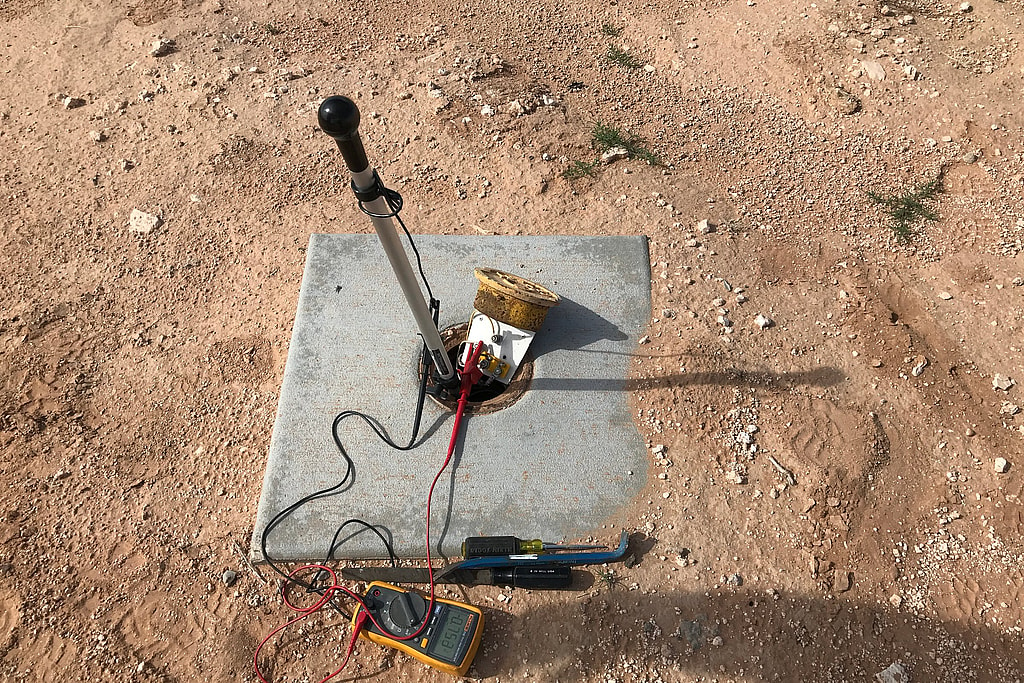
Potentials are read with a high-input-impedance voltmeter against a copper/copper sulfate reference electrode placed on the soil over the pipe. Interrupters are synchronized by GPS so that every influencing rectifier switches at the same moment; if one keeps running, its current stays in the “off” reading and the pipe looks better protected than it is. Where readings fluctuate, a data logger records the on and off cycle, so switching spikes, interrupters out of step or stray current show up in the field instead of in the report. Galvanic anodes bonded directly to the pipe cannot be interrupted, and where they are present the report explains how they affect the numbers.
Our free CP test station readings tool shows how on, instant-off and polarization values relate, and our interference testing service takes over where a foreign line, a DC transit system or a power line is affecting the readings.
What you receive
- A table of on and instant-off potentials at every location, against the criterion you use, with every shortfall flagged
- Rectifier and anode readings, compared with earlier surveys where we have them
- Results of the bond, diode, switch, isolation and casing checks
- Photographs and field observations, such as exposed pipe or missing test stations
- Problems ranked by priority, with the likely cause and the recommended fix or follow-up survey
- A report formatted for your compliance records, written so an inspector can follow it years later
When the survey finds a problem
Deficiencies have to be corrected promptly (49 CFR 192.465(d)). For onshore gas transmission lines the rule is specific: a remedial action plan, with permit applications, within 6 months of the test that found the problem, and the repair finished by the earliest of the next test interval, one year (not more than 15 months), or 6 months after the permits are obtained. Hazardous liquid lines follow 49 CFR 195.401(b), or the integrity management rule where the line is covered by it.
We look for the cause before recommending a fix. Low readings can come from a rectifier set too low, a groundbed drying out, a shorted casing, a failed insulating flange, coating damage or interference. At a power station in El Paso, our annual surveys tracked one rectifier circuit rising from 2.9 to 19.2 ohms between January 2023 and May 2026 as its deep wells dried out, and the reports recommended a regular watering routine. Where coating damage is the likely cause, a DCVG survey finds it; where the system needs anodes, a rectifier or a retrofit, a licensed Professional Engineer seals the cathodic protection design. Our article on why CP systems stop working covers the common causes in more depth.
Who we work for, and when to call
We survey gas distribution systems, gathering and transmission lines, hazardous liquid lines, plant piping, water lines and tanks. Small operators can hand us the whole calendar; our page on cathodic protection for municipal gas systems explains how that works, and our article on Colorado pipeline and flowline compliance covers the rules in that state. Call us when:
- The 15 month limit is approaching and nobody is scheduled
- You have taken over a system with incomplete records or maps
- Last year’s readings fell short and the cause was never found
- A rectifier was replaced, a line was extended or new construction crossed the route
Frequently asked questions
How often is a cathodic protection survey required?
For regulated gas and hazardous liquid pipelines, at least once each calendar year with no more than 15 months between surveys, and rectifiers six times a year. Underground storage tanks with CP are tested within 6 months of installation and then at least every 3 years.
What is checked during an annual CP survey?
Rectifier output, structure-to-soil potentials at test stations and other test points, interference bonds, diodes and reverse current switches, and the isolation that keeps the protected section separate from other structures.
How long do CP survey records have to be kept?
At least 5 years for most test and inspection records, and for as long as the pipeline remains in service for the annual survey records and the re-evaluation of unprotected pipe (49 CFR 192.491 and 195.589).
What happens if a test station reading fails?
The deficiency has to be corrected promptly. We find the cause first, whether a rectifier setting, a short, a failed flange, coating damage or interference, and on gas transmission lines with a systemic cause, a close interval survey is required in both directions from the test station.
Schedule your annual survey
Tell us the system, the number of rectifiers and test stations and when the last survey was done, and we will plan the next one inside your interval. Request a free quote. We typically respond within one business day.
Get your project started
We typically respond within one business day.