Consulting Areas
AC Current Attenuation (ACCA) Coating Surveys
We typically respond within one business day.
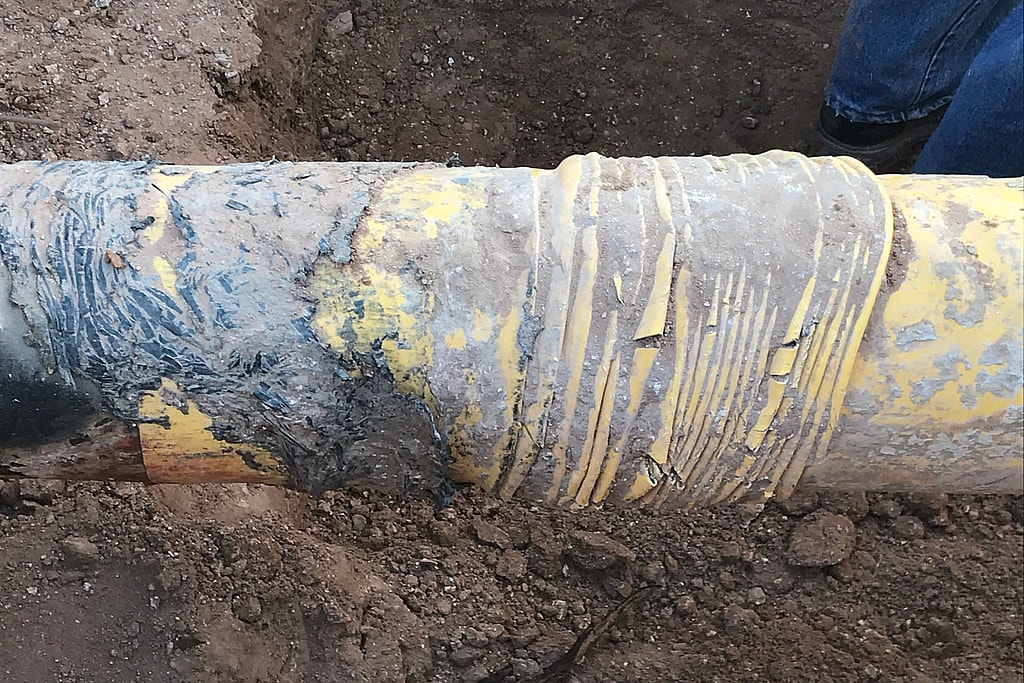
What an ACCA survey measures
An alternating current current attenuation survey, usually called ACCA, measures how much of an applied signal current is still flowing on a buried pipeline as you move away from the point where it was applied. A transmitter connected to the pipe puts a low frequency AC signal on it. A receiver carried along the route, directly over the pipe, measures the magnetic field that current produces and works out the current flowing on the pipe at that point, correcting for depth.
The signal leaks to earth along the way. How fast it falls off depends on the condition of the coating, the resistivity of the soil and the electrical resistance of the pipe. On a well-coated line the current drops slowly and evenly; where the coating has deteriorated it drops faster, and where current leaves through a coating fault or a contact with another metal structure it drops in a step. Reading that pattern of loss is how ACCA grades the coating along a line, section by section, without digging.
This page covers ACCA as a coating assessment. The same instrument is also used to trace a line, find contacts with foreign structures and check shorted casings; that work is described on our page for pipeline current mapping.
Why coating condition matters
Coating is the first defense against external corrosion, and cathodic protection is the second. Where coating fails, the steel depends entirely on CP, and the CP system has to supply more current to protect it. A line whose coating is breaking down over long stretches shows up as rising rectifier output and falling potentials, often before anyone can say where the problem is. ACCA answers the “where” at the scale of the whole line. The manufacturer of the instrument we use notes that the loss of signal current at a fault is nearly proportional to the CP current being used there, so the sections that lose the most signal are the ones drawing the most protective current.
ACCA also has a place in integrity programs. External corrosion direct assessment (ECDA) under 49 CFR 192.925 and 195.588 follows NACE SP0502 and requires at least two different but complementary indirect inspection tools for each ECDA region. ACCA is one of the methods SP0502 describes, and it pairs well with a tool that pinpoints individual faults. On lines that cannot be pigged, such as plant fuel gas lines, above-grade surveys like this are the practical way to judge external condition. Our page on direct assessment explains the four ECDA steps.
How to read an attenuation profile
Plotted in milliamps, signal current falls along a curve, steepest near the transmitter, which makes faults far down the line look smaller than they are. Plotted on a logarithmic scale (dBmA), a uniformly coated line becomes a straight sloping line, and equal faults produce equal steps wherever they are. The slope of each straight section is its attenuation rate, and comparing those rates is how sections are ranked.
| Pattern in the profile | What it usually means | Typical next step |
|---|---|---|
| Shallow, steady slope | Coating in good condition, or dry, resistive ground | Record as a baseline for later surveys |
| Steeper, steady slope over a section | General coating deterioration, or more conductive soil | Compare with soil data; rank the section for closer survey |
| A sharp step down | Localized current loss: a coating fault or a contact | Pinpoint with ACVG; check for foreign structures |
| A step with field distortion directly over it and no recovery | Likely contact with another pipe, cable or casing | Trace the foreign structure; test isolation |
| Current splitting between branches | Tie-ins, loops or a branch line carrying part of the signal | Follow the branch with the larger current |
Readings near a fault can dip and then rise again for a few meters on either side, because fault current in the soil distorts the field around the pipe. That is why a whole section is surveyed first, at equal spacing, before any detailed work is done on a suspect area.
How we run an ACCA survey
- Plan the sections. We review drawings and records for isolation points, tie-ins, casings and foreign lines, and choose transmitter connection points so each section is bounded by known features.
- Connect the transmitter. The transmitter is connected to the pipe at a test station, valve setting or rectifier location, with a ground such as an existing anode bed or a temporary anode.
- Locate before measuring. The receiver is placed directly over and in line with the pipe. The instrument rejects current and depth readings when it is out of alignment or the signal is too weak, and a peak and null locate that disagree by more than about 6 inches is a sign of a distorted field.
- Log readings at equal spacing. Signal current, depth and GPS position are saved at regular intervals along the route, closer where the profile changes.
- Plot and rank. The data are plotted in dBmA, the attenuation rate of each section is calculated, and sections are ranked from best to worst coating.
- Follow up where it matters. Steps and steep sections are surveyed in detail with an A-frame (ACVG) to pinpoint and grade individual faults, and a close interval survey shows whether CP is reaching the steel there.
Planning a coating assessment or an ECDA program? Request a free quote and send us the line length and a map. We typically respond within one business day.
Equipment
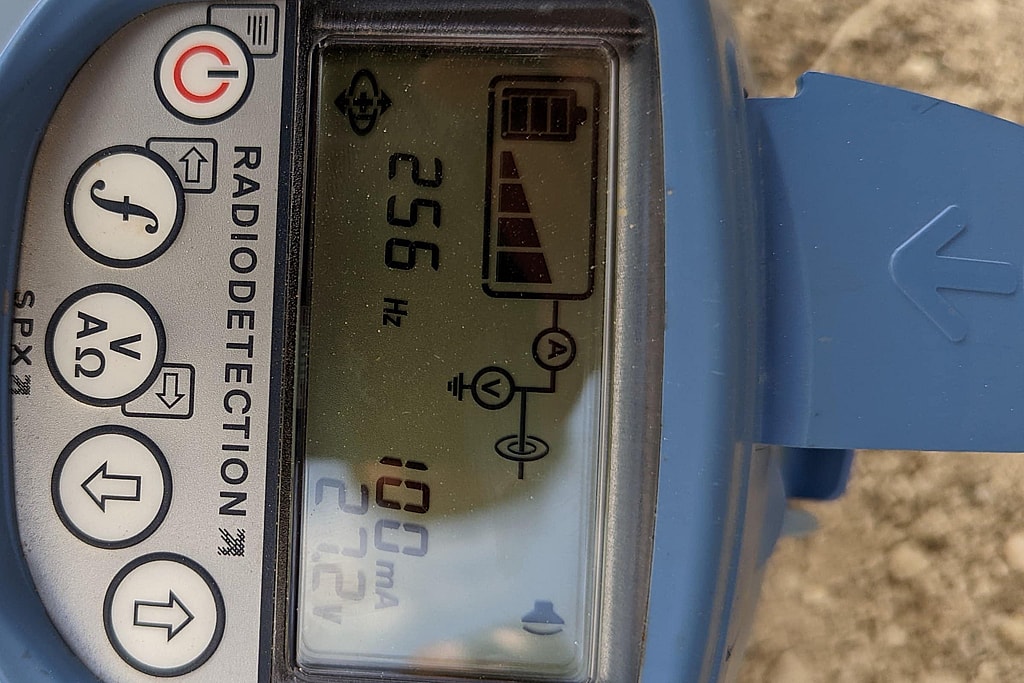
We use a Radiodetection® PCMx® pipeline current mapper. Its transmitter puts out a 4 Hz signal for current measurement together with a higher locate frequency; at 4 Hz, losses through the capacitance of the coating are minimal, so the measured loss reflects current actually leaving the pipe. The long-range transmitter is rated for signals of up to about 30 km (20 miles), which means fewer connection points. The receiver records depth and GPS position with every current reading, and the data can be exported for plotting and mapping. With an A-frame attached, the same receiver runs the ACVG survey, and the two surveys can be done on one pass. We have used this equipment on a survey program covering about 40 miles of new 20-inch pipeline in Central Texas and on the fuel gas line of a power station in El Paso, where validation digs confirmed the coating holiday the survey had found.
The manufacturer cautions that on well-coated pipe, high transmitter output can push a high current density through small holidays and cause minor corrosion if left on for long periods, so output is kept to what the survey needs.

What ACCA does not tell you
ACCA shows where signal current leaves the pipe. It does not show whether the steel at that spot is corroding or protected, and it does not pinpoint a single small holiday. Parallel lines and congested corridors distort the magnetic field, and dry, rocky ground can make a section look better coated than it is. For those reasons, ACCA results are paired with ACVG or DCVG to locate and grade faults, with a close interval survey for CP levels, and with digs before major spending. ACCA is also different from AC interference work: induced AC from power lines is assessed through interference testing and, where needed, AC mitigation design.
What you receive
- Attenuation profiles for each section, in mA and dBmA, with features such as road crossings, valves and tie-ins marked
- A table of sections ranked by attenuation rate, from best to worst coating
- GPS positions and depth readings, ready for your mapping system
- A list of localized current losses with the recommended follow-up: ACVG, DCVG, close interval survey or excavation
- Notes on isolation, suspected contacts and anything that limits how the data should be read
When to call us
- CP current demand on a line keeps rising and nobody knows where it is going
- An ECDA plan needs a second, complementary indirect inspection tool
- The line cannot be pigged and you need a picture of its coating
- You are budgeting recoating or replacement and want to rank sections first
- You acquired a line with no coating history
Frequently asked questions
What is an ACCA survey?
An alternating current current attenuation survey. A low frequency signal is applied to the pipe and measured from the surface along the route; the rate at which it falls off shows coating condition, and sudden drops show faults or contacts.
What is the difference between ACCA and ACVG?
ACCA measures the current on the pipe and grades the coating section by section. ACVG measures the voltage gradient in the soil with an A-frame and pinpoints individual coating faults. They are often run together, ACCA to find the bad sections and ACVG to find the faults within them.
Can ACCA find coating holidays?
It finds where current is being lost, which points to holidays and contacts, but it does not pinpoint a single small holiday. That is done with ACVG or DCVG.
Does the CP system have to be running for an ACCA survey?
No. The survey uses its own transmitter signal, so it can be run on lines without working CP, including new lines before the permanent system is energized.
Talk to an engineer
Tell us about the line, its coating and what the CP data have been showing. Request a free quote. We typically respond within one business day.
Get your project started
We typically respond within one business day.